English translation
5 Basic Prompting Techniques for DeepSeek-R1
AI Article Decision Snapshot
Turn the lesson into workflow, model, budget, and security checks before choosing tools.
Use this quick snapshot before leaving the article. It keeps the next search tied to practical AI software, model/API, cost, privacy, and implementation questions.
Workflow fit
Identify the real job behind the article: coding, research, document review, support, analytics, content, or internal automation.
Model or tool decision
Decide whether the next step is a software shortlist, an AI tool comparison, an API platform choice, or a model benchmark.
Budget and usage signal
Estimate seats, API calls, prompt volume, retries, review time, and fallback work before assuming the workflow is cheap.
Security and privacy review
Check whether source code, customer data, private documents, prompts, logs, or embeddings will enter the AI workflow.
You don’t need to make prompts sound mysterious or overly complex. From my experience, clearly defining the task boundaries upfront helps the model avoid many unnecessary detours. For example, when asking it to “write Python code,” specifying the input data, output format, required libraries, and exception-handling logic is far more effective than piling on vague adjectives.

Try rewriting one of your own real-world questions three times:
- First, write only a single sentence.
- Second, add role definition and objective.
- Third, further specify output format and acceptance criteria.
Comparing the three responses will give you an intuitive sense of exactly where and how much the prompt influenced the result.
Well-crafted prompts can dramatically improve both the quality and accuracy of DeepSeek-R1’s responses. Applying professional prompt engineering techniques enables the model to better understand your intent—leading to more precise, reliable, and domain-appropriate outputs.
1. Core Principles for Prompt Optimization
When designing prompts, follow these foundational principles:
- Clarity & Specificity: Avoid vague or open-ended phrasing; provide concrete context.
- Persona Setting: Assign the model a specific role—for example, “As a senior data scientist, explain…”
- Goal-Oriented Design: Explicitly state the desired output format—e.g., code, step-by-step instructions, or a table.
- Few-Shot Prompting: Include illustrative examples to guide the model toward your preferred response style.
2. Basic Structure of an Effective Prompt
A high-quality prompt typically consists of the following components:
[Persona] You are a [role], expert in [domain].
[Task] Your task is to [specific action].
[Content Requirements] Please explain [topic] in detail, formatted as [output format].
[Constraints] Do not include [unwanted content]; keep your response under [word count].
Example:
You are a professional Python data analyst skilled in Pandas and NumPy.
Write a Python function to clean data from a CSV file, with the following requirements:
1. Drop columns with >50% missing values
2. Impute missing values in numeric columns using the mean
3. Standardize numeric columns
Include detailed comments and output the code in a Python code block.
3. Prompt Optimization Techniques
3.1 Persona Setting
Assign DeepSeek-R1 a specialized role to elicit more authoritative, domain-specific responses.
Example
✅ Basic Prompt:
Explain the Transformer architecture.
🚀 Optimized Prompt:
You are a deep learning expert. Explain the Transformer mechanism in plain, accessible language—and use analogies to aid understanding.
3.2 Constraining Response Scope
Explicitly limit how the model should respond to ensure alignment with your needs.
Example
✅ Basic Prompt:
Introduce deep learning.
🚀 Optimized Prompt:
Summarize deep learning in no more than 300 words, and list three common application domains.
3.3 Structured Output
Require DeepSeek-R1 to return results in a predefined format—e.g., tables, JSON, or Markdown.
Example
✅ Basic Prompt:
List commonly used Python libraries.
🚀 Optimized Prompt:
List commonly used Python libraries and their primary purposes in the following Markdown table format:
| Library Name | Primary Use Case |
|--------------|------------------|
| NumPy        | Scientific computing |
| Pandas       | Data manipulation |
3.4 Specifying Reasoning Style
Use Chain-of-Thought (CoT) prompting to encourage step-by-step reasoning—boosting correctness and interpretability.
Example
✅ Basic Prompt:
What is 15% of 200?
🚀 Optimized Prompt:
Calculate 15% of 200 step by step, explaining each stage of the computation.
🔍 Sample Output:
1. Compute 15%: 200 × 0.15 = 30
2. Therefore, 15% of 200 is 30.
4. Professional Prompt Examples
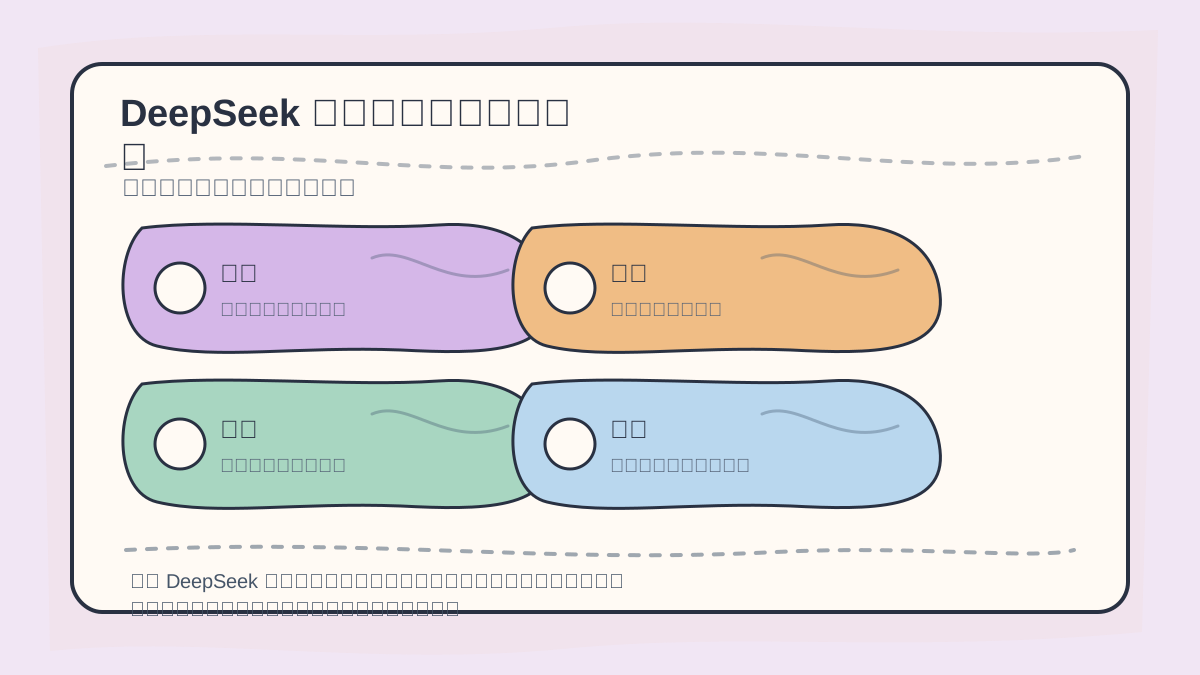
When crafting prompts for DeepSeek, always begin by clarifying:
- The task,
- Relevant contextual materials,
- Required output format, and
- Any constraints.
The clearer the boundaries, the easier it is to review, validate, and reuse the output.
4.1 Code Generation
✅ Basic Prompt:
Implement binary search in Python.
🚀 Optimized Prompt:
You are a Python algorithms expert. Implement binary search in Python with comprehensive inline comments:
```python
def binary_search(arr, target):
    left, right = 0, len(arr) - 1
    while left <= right:
        mid = (left + right) // 2
        if arr[mid] == target:
            return mid
        elif arr[mid] < target:
            left = mid + 1
        else:
            right = mid - 1
    return -1
4.2 Data Analysis
✅ Basic Prompt:
How do I handle missing data with Pandas?
🚀 Optimized Prompt:
Use Pandas to handle missing values in the following dataset:
1. Drop columns with >50% missing values
2. Fill missing values in numeric columns with the column mean
3. Remove rows with >30% missing values

Provide complete, executable Pandas code and explain the logic behind each step.
4.3 Academic Writing
✅ Basic Prompt:
Describe CNN applications in computer vision.
🚀 Optimized Prompt:
You are a computer vision researcher. Write a ~500-word article describing CNN applications in computer vision, including three landmark case studies.
4.4 Professional Translation
✅ Basic Prompt:
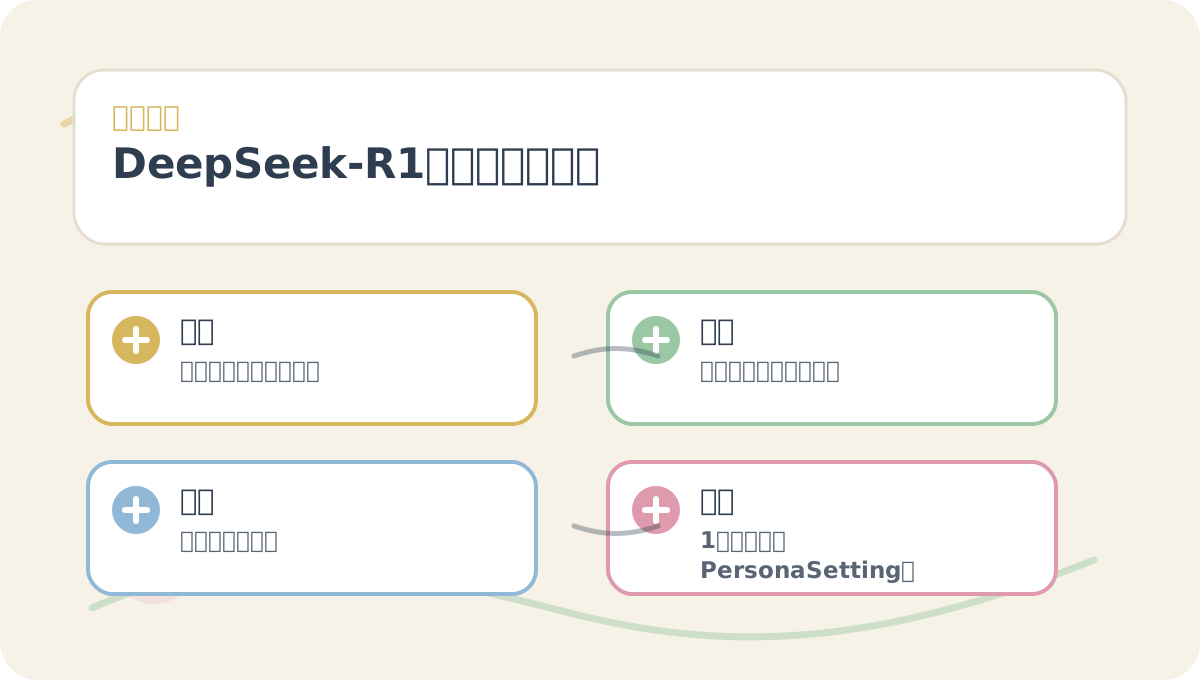
When reading “DeepSeek-R1 Prompt Basics”, first examine the task, concepts, exercises, and judgment points illustrated in the accompanying figures—then return to the main text to fill in details. This approach makes it easier to map the content to real-world use cases.
Translate this English text.
🚀 Optimized Prompt:
You are a professional Chinese–English translator. Translate the following English text into formal written Chinese:
[Input English text]
Preserve all technical terminology and adhere to standard Chinese syntax and stylistic conventions.
4.5 Deep Learning Tasks
✅ Basic Prompt:
Train an MNIST classifier using PyTorch.
🚀 Optimized Prompt:
You are a deep learning engineer. Train a handwritten digit classifier on MNIST using PyTorch:
- Use a CNN architecture
- Train for 10 epochs
- Log and display training loss and accuracy per epoch
- Include thorough inline comments throughout the code
5. Advanced Prompting Techniques
| Technique | Purpose | Example |
|---|---|---|
| Persona Setting | Guides model to respond as a domain expert | “You are an AI research scientist…” |
| Structured Output | Enforces consistent, machine-readable formats | “List Python libraries in a Markdown table…” |
| Step-by-Step Reasoning | Improves accuracy via explicit decomposition | “Compute X step by step…” |
| Length Constraints | Ensures concision and focus | “Summarize Transformer in ≤300 words…” |
| Few-Shot Prompting | Demonstrates expected output style via examples | “Format your answer like the examples below…” |
When reviewing “DeepSeek-R1 Prompt Basics”, consolidate key concepts, procedural steps, and observable outcomes on a single page for efficient reflection.
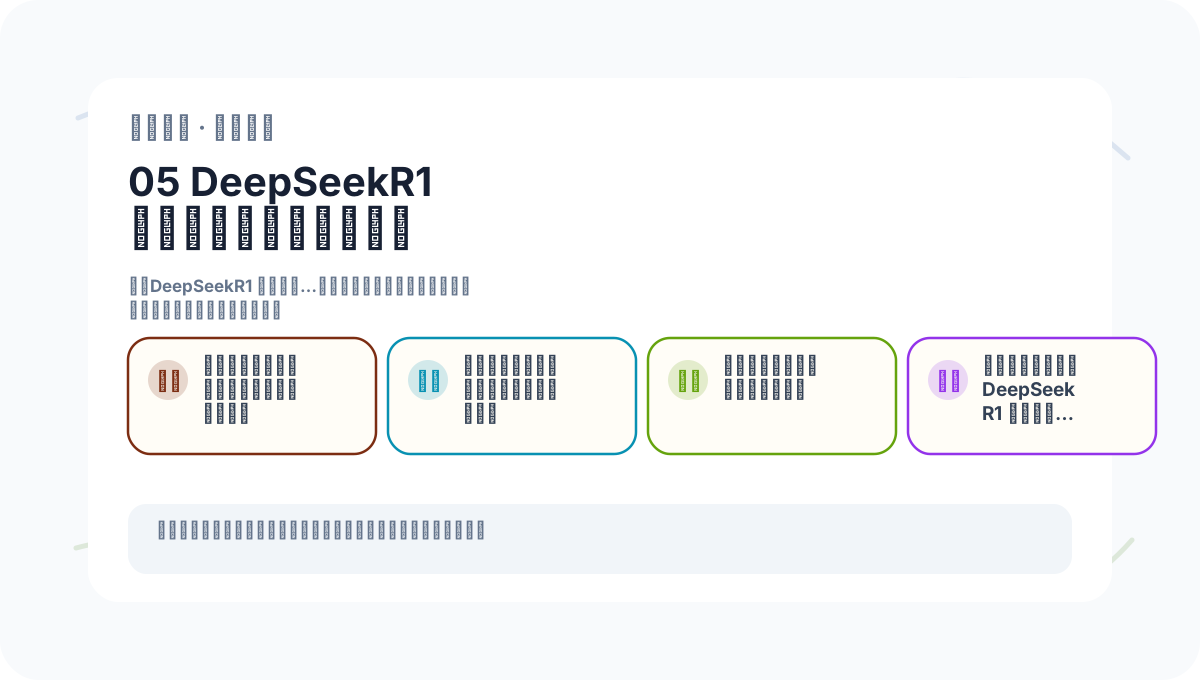
When practicing “DeepSeek-R1 Prompt Basics”, record the input conditions, processing actions, and observable outputs together—making future verification and iteration straightforward.
6. Conclusion
By refining your prompts, DeepSeek-R1 delivers responses that are significantly more professional, accurate, and aligned with your actual needs. Adapting prompt structure across different use cases—emphasizing clarity, specificity, and intentionality—greatly enhances the model’s practical utility.
💡 Quick Prompt Optimization Tips:
- Define a clear persona
- Require step-by-step reasoning
- Enforce length and format constraints
- Leverage few-shot examples
Master these techniques—and unlock the full potential of DeepSeek-R1! 🚀
Apply This Lesson
Turn this article into AI software, model, API, and security decisions.
English Article FAQ
Use this article as evidence before choosing AI tools
How should I use this AI Tutorials article?
Use it as the implementation or learning layer, then connect the idea to AI software buyer guides, tool comparisons, benchmarks, API choices, and security checks before making a production decision.
Is this English article different from the Chinese original?
The English edition is localized for global AI readers while preserving the original diagrams, screenshots, prompts, code examples, and source context from the Chinese article.
What should I read after 5 Basic Prompting Techniques for DeepSeek-R1?
Continue with AI Software Buyer Guides, AI Tools Workbench, Best AI Coding Agents, AI Model Benchmarks, OpenAI vs Anthropic API, or LLM Security Tools depending on the decision you need to make.
Can this article alone choose an AI product or model?
No. Treat the article as evidence and context, then validate fit with pricing, privacy requirements, integration effort, benchmark results, workflow tests, and fallback planning.
Continue