English translation
Load CSV file
AI Article Decision Snapshot
Turn the lesson into workflow, model, budget, and security checks before choosing tools.
Use this quick snapshot before leaving the article. It keeps the next search tied to practical AI software, model/API, cost, privacy, and implementation questions.
Workflow fit
Identify the real job behind the article: coding, research, document review, support, analytics, content, or internal automation.
Model or tool decision
Decide whether the next step is a software shortlist, an AI tool comparison, an API platform choice, or a model benchmark.
Budget and usage signal
Estimate seats, API calls, prompt volume, retries, review time, and fallback work before assuming the workflow is cheap.
Security and privacy review
Check whether source code, customer data, private documents, prompts, logs, or embeddings will enter the AI workflow.
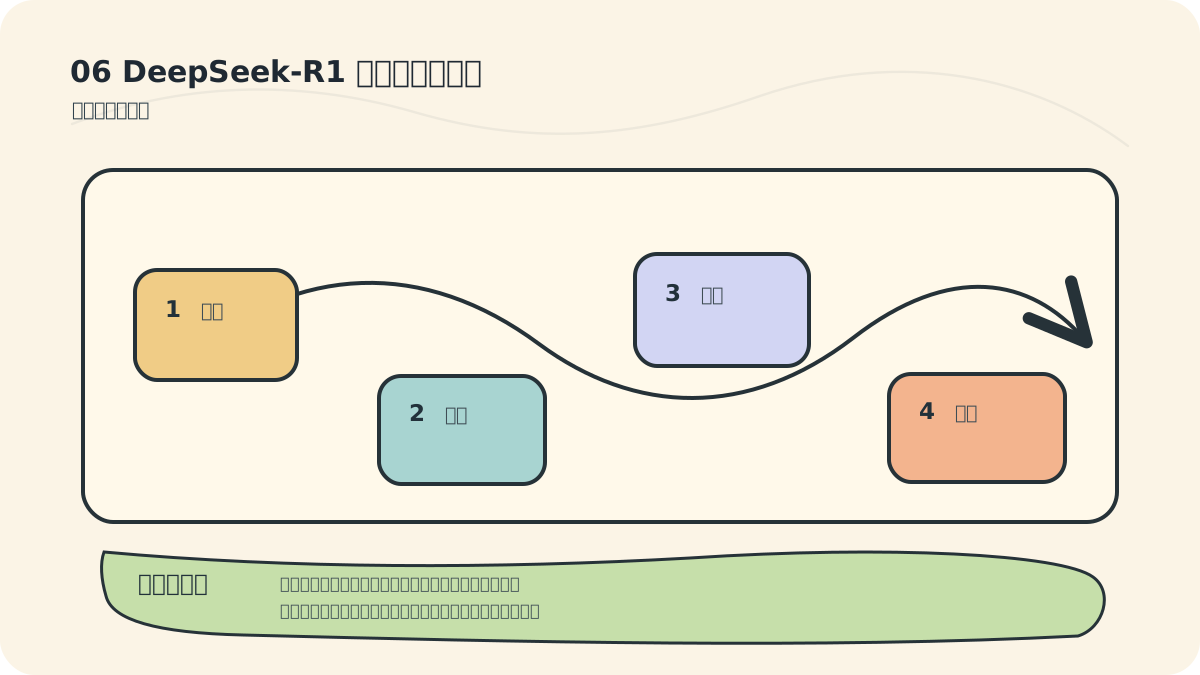
Advanced prompting isn’t about writing longer sentences—it’s about decomposing tasks into steps the model can execute reliably. For analytical tasks, coding, or planning, I first ask the model to outline a step-by-step plan, then guide it through each step sequentially, and finally request a dedicated verification pass. This approach is far more robust than demanding a “perfect answer” all at once.

We recommend building your own reusable prompt template: Background, Objective, Input Materials, Output Format, Constraints, and Self-Check Items. Whenever tackling a complex task, start from this template—and adapt it—rather than improvising prompts on the spot. The more closely your template mirrors your actual workflow (not generic online examples), the more effective it becomes.
When using DeepSeek-R1 for efficient dialogue and task execution, advanced prompt engineering significantly enhances model performance—yielding responses that are more professional, precise, and aligned with your specific requirements. This guide focuses on advanced strategies, illustrated with real-world examples, to help you design highly effective prompts.
🔹 1. Deeply Structured Prompts
1.1 Predefined Format
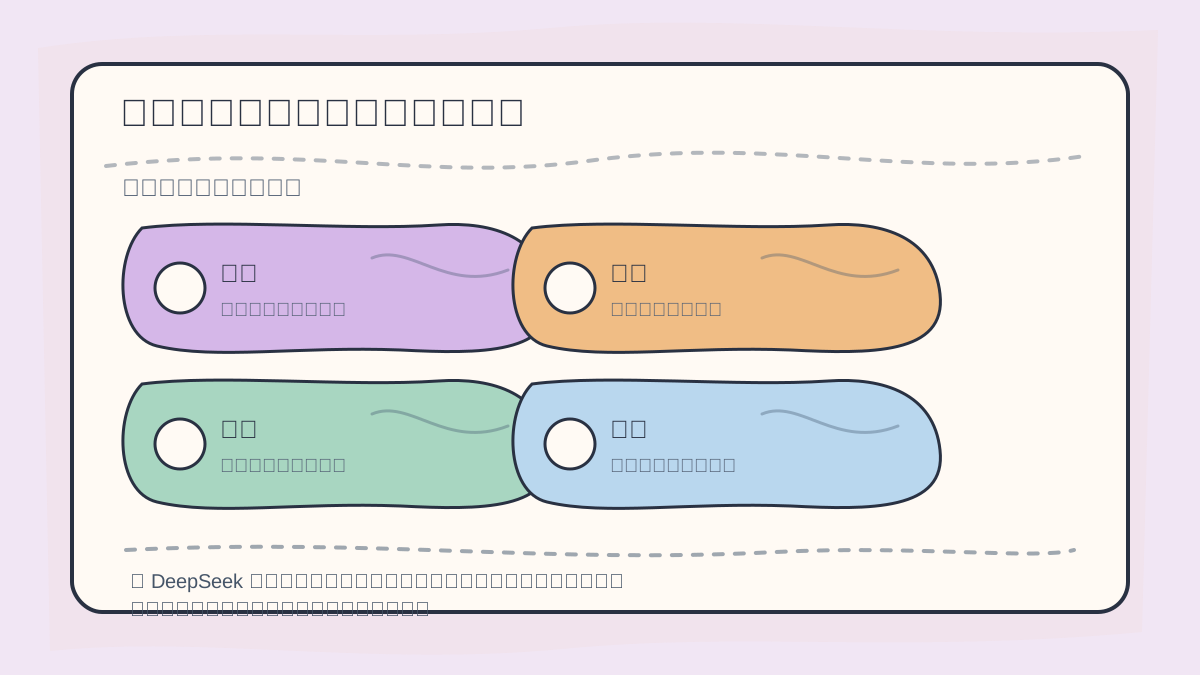
When crafting advanced prompts for DeepSeek, separate key components clearly: role, steps, input materials, output format, and self-check points. The more complex the task, the more critical intermediate outputs become.
Explicitly specifying output format helps DeepSeek-R1 generate well-structured, unambiguous content. For example:
✅ Poor Example:
Give me a Python data cleaning example.
🚀 Optimized Version:
You are a Python data engineer. Output a data-cleaning script in a Markdown code block, performing the following:
1. Load a CSV file
2. Drop columns where >50% of values are missing
3. Fill remaining missing values with column-wise means
4. Standardize numeric columns
Use **Pandas**, and include explanatory comments after the code.
📌 Key Improvements:
- Format specification: Markdown code block
- Step clarity: Explicit, ordered instructions
- Library constraint: Pandas only
Sample Output:
import pandas as pd

# Load CSV file
df = pd.read_csv("data.csv")

# Drop columns with >50% missing values
df = df.dropna(thresh=len(df) * 0.5, axis=1)

# Fill remaining NaNs with column means
df.fillna(df.mean(), inplace=True)

# Standardize numeric columns
numeric_cols = df.select_dtypes(include=['number']).columns
df[numeric_cols] = (df[numeric_cols] - df[numeric_cols].mean()) / df[numeric_cols].std()

print(df.head())
🔹 2. Dynamic Prompt Optimization
DeepSeek-R1 delivers more expert-level responses when provided with contextual augmentation, such as background context, data descriptions, or existing code snippets.
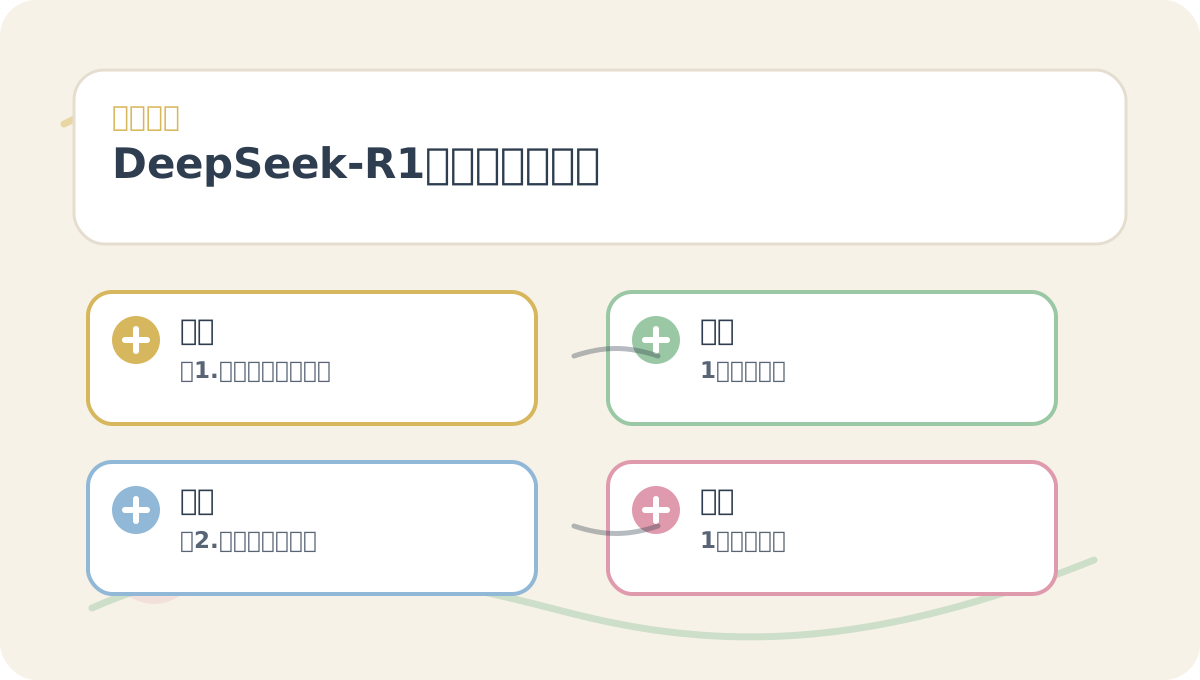
While reading “Advanced Prompt Engineering for DeepSeek-R1”, first examine the task, concepts, exercises, and evaluation criteria shown in the accompanying figures—then return to the main text to fill in technical details. This makes it easier to map the content directly to your real-world use cases.
2.1 Context Integration
✅ Poor Example:
Help me optimize this SQL query.
🚀 Optimized Version:
You are an SQL performance optimization specialist. Optimize the following query for maximum execution efficiency:
```sql
SELECT * FROM orders WHERE customer_id = 12345;
Consider:
- Index optimization: Is an appropriate index in place?
- Query logic: Is the WHERE condition optimal?
- Database engine: Is this running on MySQL or PostgreSQL? Output your optimized solution in a Markdown code block, accompanied by concise explanations.
📌 **Key Improvements**:
- Provides the **original SQL**
- Specifies **optimization dimensions**
- Enforces **structured output** (code block + explanation)

**Sample Output**:
```sql
-- Add index to accelerate lookups
CREATE INDEX idx_customer_id ON orders(customer_id);

-- Optimized query leveraging the new index
SELECT * FROM orders WHERE customer_id = 12345;
📌 Why It Works:
CREATE INDEXdirectly addresses the bottleneck- Original
WHEREclause remains valid and now benefits from indexing
🔹 3. Advanced Logical Reasoning (Multi-Step Reasoning)
For questions requiring multi-step reasoning, DeepSeek-R1 may skip subtleties or omit intermediate logic. You can improve accuracy by explicitly requesting Chain-of-Thought (CoT) reasoning—guiding the model to think step-by-step.
3.1 Stepwise Reasoning
✅ Poor Example:
Calculate 23 factorial.
🚀 Optimized Version:
Compute **23! (23 factorial)** step-by-step, with full justification:
1. **State the definition**: 23! = 23 × 22 × 21 × … × 1
2. **Show key intermediate products** (e.g., first 3–5 multiplications)
3. **Provide a Python implementation**
Output the Python code in a **Markdown code block**.
📌 Key Improvements:
- Enforces explicit decomposition
- Includes mathematical definition
- Requires executable code output
Sample Output:
Steps to compute 23!:
1. 23 × 22 = 506
2. 506 × 21 = 10,626
3. 10,626 × 20 = 212,520
...
import math
print(math.factorial(23))  # Final result
🔹 4. Reverse Prompting
If DeepSeek-R1’s output feels vague or incomplete, prompt it to reflect critically on its own response, ensuring completeness and precision.
4.1 Self-Verification Prompting
✅ Poor Example:
Explain the Transformer architecture.
🚀 Optimized Version:
You are a deep learning researcher. Explain the Transformer mechanism **clearly and rigorously**, structured as follows:
1. **Summarize the core idea in two sentences.**
2. **Detail Self-Attention and Multi-Head Attention mechanisms.**
3. **Assume your answer will undergo expert peer review—identify and fill any critical omissions.**
📌 Key Improvements:
- Starts with concise conceptual summary
- Proceeds to technical depth
- Ends with self-audit requirement, improving reliability
🔹 5. Professional-Grade Prompt Template
To consistently elicit high-fidelity, domain-accurate outputs, use this universal template:
You are a [role], deeply experienced in [domain].
Explain [topic] following these steps:
1. [Step 1]
2. [Step 2]
3. [Step 3]
Output in [format] (e.g., Markdown table, code block, LaTeX equations).
[Additional constraints]: e.g., include working code, real-world examples, or mathematical derivations.
[Self-check]: Does your response omit any essential concepts or practical considerations?
✅ Example:
You are an AI researcher specializing in Transformer architectures.
Explain the **Transformer model** thoroughly:
1. Summarize its essence in two sentences.
2. Explain the Self-Attention mechanism.
3. Provide a minimal PyTorch implementation.
Output all code in **Markdown code blocks**, and verify whether any foundational concepts were omitted.
📌 Sample Output:
The Transformer is a self-attention-based neural architecture designed for sequence modeling—especially in NLP—eliminating recurrence and enabling parallel training.
It relies on scaled dot-product attention and positional encodings to capture long-range dependencies.

import torch
import torch.nn as nn

class TransformerModel(nn.Module):
    def __init__(self, input_dim, hidden_dim):
        super().__init__()
        self.attention = nn.MultiheadAttention(hidden_dim, num_heads=8)
    def forward(self, x):
        return self.attention(x, x, x)
🔹 6. Ultimate Prompt Optimization Techniques
| Technique | Purpose | Example |
|---|---|---|
| Structured Prompting | Enforce consistent, machine-readable output | “List common Python libraries in a Markdown table.” |
| Role Assignment | Anchor responses in domain expertise | “You are a senior database architect…” |
| Multi-Step Reasoning | Guide logical decomposition | “Compute 23! step-by-step…” |
| Reverse Verification | Trigger model self-auditing | “Identify and add any missing components…” |
| Few-Shot Guidance | Improve fidelity via exemplars | “Follow the exact format below…” |
After completing “Advanced Prompt Engineering for DeepSeek-R1”, try adapting it to one of your own workflows—pay close attention to how inputs, processing logic, and outputs align end-to-end.
To integrate “Advanced Prompt Engineering for DeepSeek-R1” into your work, begin small: isolate one critical decision point, and validate the prompt there first.
Conclusion
By applying advanced prompt engineering techniques, you unlock higher professionalism, precision, and task alignment from DeepSeek-R1. Mastering structured output formatting, multi-step reasoning, role-based framing, and reverse self-checking empowers the model to deliver exceptional results across diverse domains.
🚀 Key Optimization Principles to Remember
✅ Assign a role: Transform the model into a subject-matter expert ✅ Guide stepwise: Break down reasoning to boost accuracy ✅ Constrain format: Enforce Markdown, tables, or code blocks for predictable output ✅ Enable self-audit: Ask the model to verify completeness and correctness
With these techniques, you’ll fully harness the potential of DeepSeek-R1! 🚀💡
Apply This Lesson
Turn this article into AI software, model, API, and security decisions.
English Article FAQ
Use this article as evidence before choosing AI tools
How should I use this AI Tutorials article?
Use it as the implementation or learning layer, then connect the idea to AI software buyer guides, tool comparisons, benchmarks, API choices, and security checks before making a production decision.
Is this English article different from the Chinese original?
The English edition is localized for global AI readers while preserving the original diagrams, screenshots, prompts, code examples, and source context from the Chinese article.
What should I read after Load CSV file?
Continue with AI Software Buyer Guides, AI Tools Workbench, Best AI Coding Agents, AI Model Benchmarks, OpenAI vs Anthropic API, or LLM Security Tools depending on the decision you need to make.
Can this article alone choose an AI product or model?
No. Treat the article as evidence and context, then validate fit with pricing, privacy requirements, integration effort, benchmark results, workflow tests, and fallback planning.
Continue