English translation
7 DeepSeek Prompt Templates for Efficient Writing
AI Article Decision Snapshot
Turn the lesson into workflow, model, budget, and security checks before choosing tools.
Use this quick snapshot before leaving the article. It keeps the next search tied to practical AI software, model/API, cost, privacy, and implementation questions.
Workflow fit
Identify the real job behind the article: coding, research, document review, support, analytics, content, or internal automation.
Model or tool decision
Decide whether the next step is a software shortlist, an AI tool comparison, an API platform choice, or a model benchmark.
Budget and usage signal
Estimate seats, API calls, prompt volume, retries, review time, and fallback work before assuming the workflow is cheap.
Security and privacy review
Check whether source code, customer data, private documents, prompts, logs, or embeddings will enter the AI workflow.
I prefer to treat prompt templates as task checklists, not magic incantations. Before each use, fill in the context (scenario), input materials, and desired output requirements—then let the model generate. This way, your template evolves with your work instead of becoming a polished but impractical phrase that looks professional yet resists reuse.
You can start by saving this template into your personal notes—but avoid using it unchanged long-term. After completing each task, incorporate any inconsistencies or instability you observed in the model’s responses directly into the template—for example: “Do not fabricate URLs,” “First ask about missing information,” or “Code must be executable as-is.” That’s how robust, personalized templates gradually grow.
Recently, I’ve received numerous messages and emails from readers asking about locally deploying DeepSeek. For these questions, I’ll personally reproduce the issues and identify practical solutions—and share them all in a consolidated response when time permits. Due to the high volume, I’m unable to reply individually—please accept my apologies.
This article summarizes how to write effective prompts—focusing on actionable, practical guidance.
1 Why Prompts Matter
For large language models (LLMs), prompts are like drivers for cars. Owning a car isn’t enough—you also need basic driving skills to operate it safely and effectively. Similarly, the quality of your prompting skill directly determines how well you collaborate with an LLM. Just as poor driving leads to accidents, weak prompting leads to inaccurate, irrelevant, or hallucinated outputs. Hence, mastering prompt engineering is essential.
2 How to Write Effective Prompts
An LLM generates responses token-by-token, selecting at each step the most probable next token. Your question—or more broadly, your prompt—acts as the engine driving this entire data flow. When you press Enter, the engine starts; the prompt flows into the model, which immediately interprets it (i.e., understands your intent). Once interpretation is complete, the model begins outputting its first token, then the second, and so on.
Therefore, clarity in your prompt directly influences accuracy in each generated token. While many platforms offer extensive prompt-writing tutorials—including advanced techniques—the sheer volume of advice can feel overwhelming. You may finish reading feeling like you “got it,” only to realize later you’ve forgotten everything—and struggle to apply it practically.
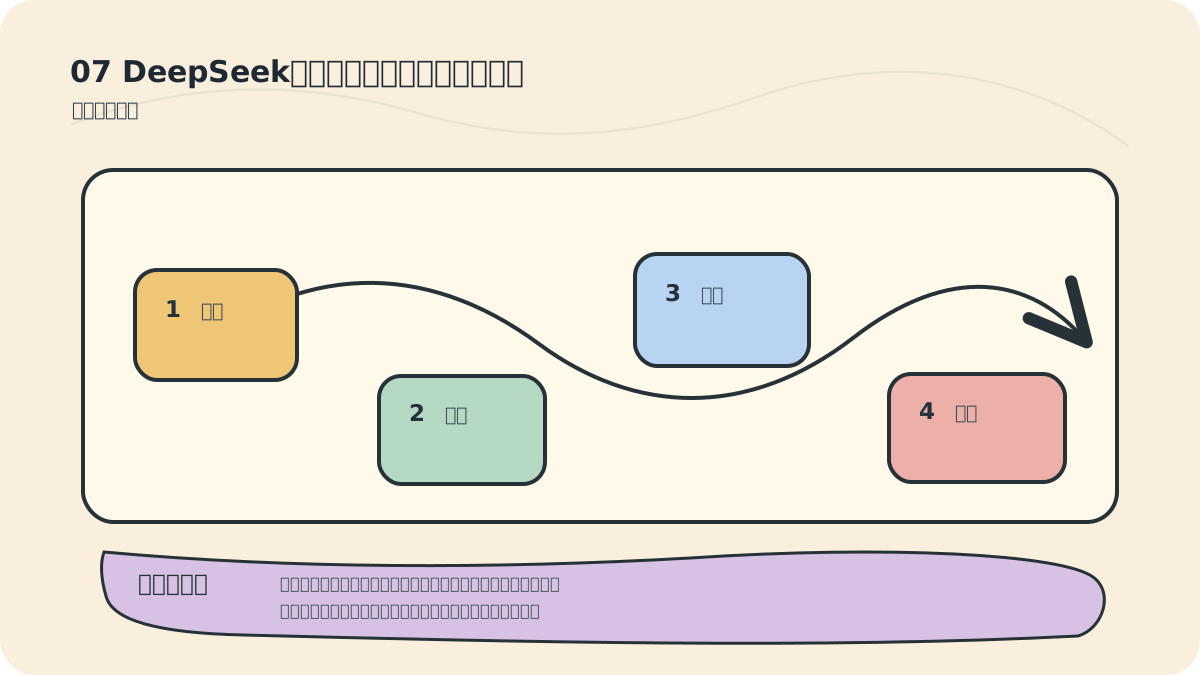
To address this, I’ve distilled a highly adaptable, general-purpose prompt template. Its structure is shown below:

This template consists of four logically sequential components: Role Definition, Task Description, Content Requirements, and Constraints. Let me walk through each.
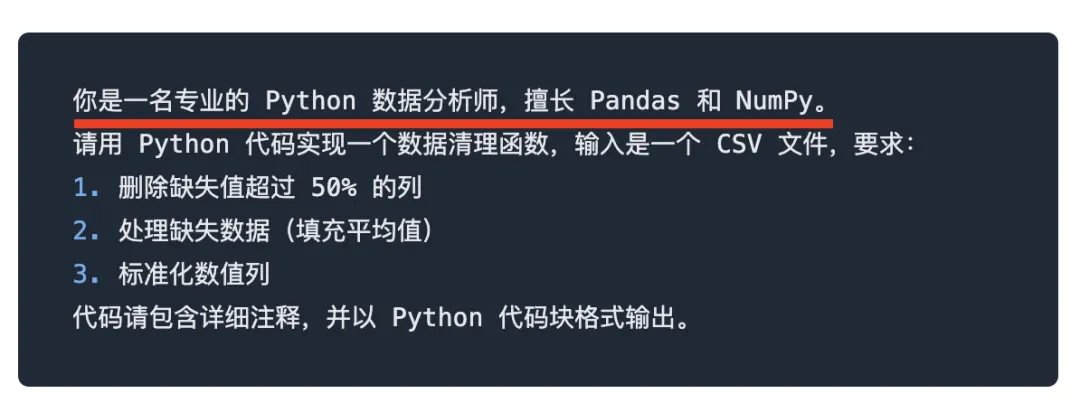
Role Definition: Research shows that explicitly assigning a role significantly improves an LLM’s problem-solving clarity. Why? Because defining a role instantly anchors the model within a specific domain—sharpening its focus and grounding its knowledge. For instance, setting the role as “Python Data Analyst” yields more precise, domain-relevant responses:
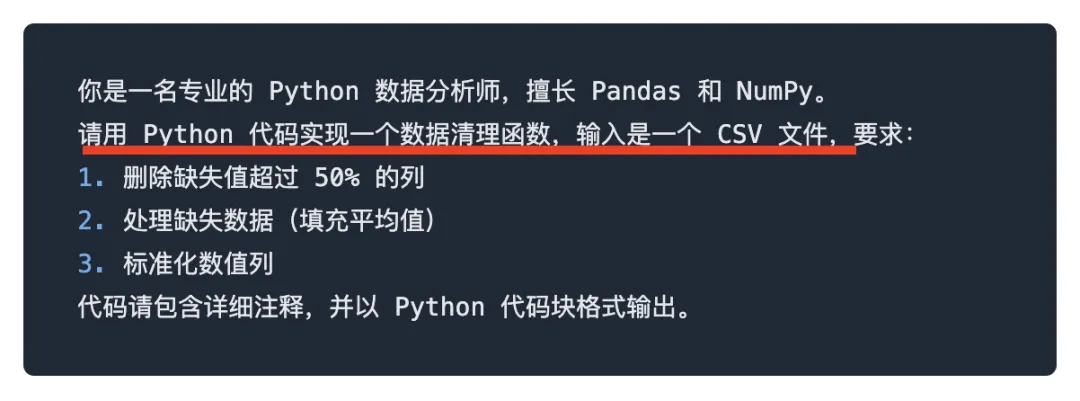
Task Description: Clearly state what you want the model to do—concisely, in one or two sentences. Avoid excessive detail here. Also specify your input: Is it just a plain question? Or does it include external files (e.g., a CSV), as illustrated below?
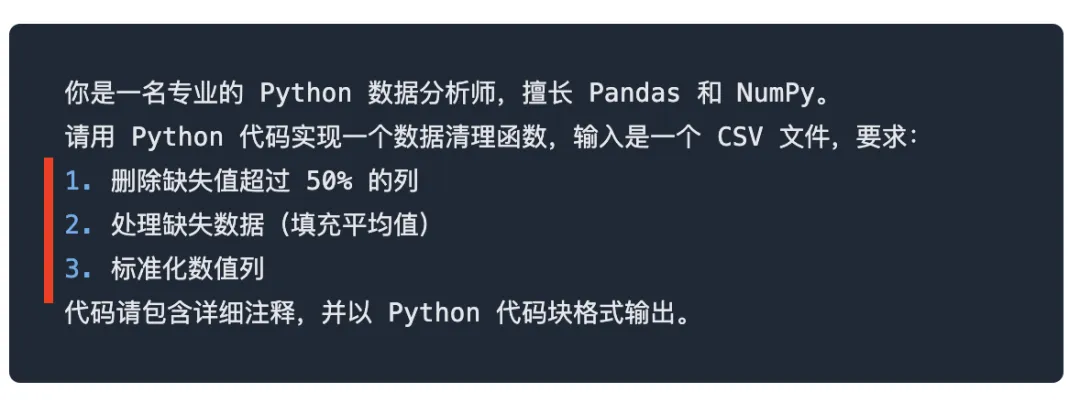
Content Requirements: These are the core, granular details of your task—broken down point-by-point. Each requirement should be self-contained and numbered (1., 2., 3., etc.). Numbered lists help the model parse and satisfy each condition more reliably:
Constraints: Specify what must not appear in the output—for example: “Do not invent URLs,” “Do not answer if critical information is missing,” or “Response must not exceed 300 words.”
When revisiting “DeepSeek Prompt Engineering: An Efficient Template!”, don’t jump straight into complex projects. Start with a simple test case to verify whether the core logic of your prompt is clear and functional.
Summary
This article introduces an efficient, four-part prompt template: ✅ Role Definition ✅ Task Description ✅ Content Requirements ✅ Constraints
Mastering these four elements makes prompt writing far more systematic and reliable. Rather than memorizing dozens of isolated tips, deeply internalize one well-structured framework—and build from there.
Apply This Lesson
Turn this article into AI software, model, API, and security decisions.
English Article FAQ
Use this article as evidence before choosing AI tools
How should I use this AI Tutorials article?
Use it as the implementation or learning layer, then connect the idea to AI software buyer guides, tool comparisons, benchmarks, API choices, and security checks before making a production decision.
Is this English article different from the Chinese original?
The English edition is localized for global AI readers while preserving the original diagrams, screenshots, prompts, code examples, and source context from the Chinese article.
What should I read after 7 DeepSeek Prompt Templates for Efficient Writing?
Continue with AI Software Buyer Guides, AI Tools Workbench, Best AI Coding Agents, AI Model Benchmarks, OpenAI vs Anthropic API, or LLM Security Tools depending on the decision you need to make.
Can this article alone choose an AI product or model?
No. Treat the article as evidence and context, then validate fit with pricing, privacy requirements, integration effort, benchmark results, workflow tests, and fallback planning.
Continue